


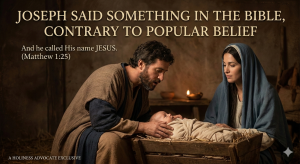
 If you spend any time scrolling through TikTok, Instagram, or “Bible Fact” threads on X, you’ve likely encountered a viral post claiming that St. Joseph, the earthly father of Jesus, is the only major biblical figure who never speaks. The narrative is framed as a profound mystery: the “Silent Knight” of the New Testament, a man so stoic and humble that not a single word of his escaped the ink of the Gospel writers.
This “silent Joseph” trope has become a staple of digital devotion. It’s a catchy, shareable sentiment that fits perfectly into a 60-second reel about quiet strength. But here is the problem: it is factually incorrect.
While it is true that Joseph doesn’t deliver long sermons like Peter or engage in dense theological debates like Paul, the Bible explicitly records a moment where Joseph breaks his silence. To say he said “nothing” is to miss the most pivotal legal and spiritual declaration of his life. Before we get to his literal spoken word, we must look at the loud, defiant language of his character—the “actions” that spoke long before his lips moved.
The Language of Character: Actions as Articulation
We often use the idiom “Actions speak louder than words.” If we apply this to the biblical narrative, Joseph becomes one of the most talkative figures in the New Testament. His character is defined by a series of deliberate, counter-cultural choices that communicate a sophisticated moral philosophy.
- “Don’t despise a person publicly, even when they have shamed you.”
In Matthew 1:19, we find Joseph in a devastating position. By the standards of first-century Jewish law, finding his betrothed pregnant was not just a personal betrayal; it was a legal grounds for public shaming or even more severe penalties.
The text notes that Joseph was a “just man.” His justice, however, was tempered with a mercy that spoke volumes. By deciding to divorce Mary quietly rather than making her a “public example,” Joseph’s actions shouted a message of restorative justice over retributive shame. He chose to protect the dignity of the person who, in his eyes at the time, had caused him the ultimate indignity.
- “Do what the Lord tells you without questioning.”
When the Angel of the Lord appeared to him in a dream to explain the divine nature of the pregnancy, Joseph didn’t wake up and demand a second opinion. Matthew 1:24 tells us that “Joseph being raised from sleep did as the angel of the Lord had bidden him.”
In a world where we often demand “signs” and engage in endless “fleece-laying” (testing God), Joseph’s immediate obedience was a loud declaration of unwavering faith. He didn’t argue with the supernatural; he integrated it into his reality instantly.
- “Self-discipline is the highest form of respect.”
Matthew 1:25 contains a detail that many modern readers gloss over: he “knew her not till she had brought forth her firstborn son.” In a cultural context where matrimonial rights were viewed as absolute, Joseph’s restraint was a radical statement. He prioritized the sanctity of the divine mission over his own physical desires. He communicated through his discipline that sacred boundaries are worth more than personal rights.
Breaking the Silence: The Name Above All Names
Now we come to the crux of the argument. Is it true that Joseph is literally silent in the text? The answer is a definitive no. The popular belief that Joseph is a “mute” character usually stems from a lack of “red-letter” dialogue—he isn’t given a long monologue or a conversation with Mary recorded in quotes. But Matthew 1:25 concludes with a specific action that required vocalization:
“And he called His name JESUS.”
To “call” a name in the biblical context is not a passive thought. It is a formal, verbal declaration. In the Jewish tradition of the time, the naming of a child was a legal and spiritual milestone. By naming the child, Joseph was doing two things that required him to speak:
- Legal Adoption: By speaking the name “Jesus” (Yeshua), Joseph was publicly and legally acknowledging the child as his own within the lineage of David.
- Prophetic Fulfillment: He was echoing the command given to him by the angel. He didn’t just name the child; he proclaimed the child’s identity as the Savior.
When Joseph stood before his community and declared, “His name is Jesus,” he uttered the most important word in the entire New Testament. He didn’t need a sermon; he needed a name. And in that one word, he fulfilled his role as the earthly guardian of the Word Made Flesh.
Why the “Silent” Narrative Persists
Why are we so obsessed with the idea that Joseph said nothing? Perhaps it is because we live in an era of “noise.” We equate importance with the volume of words produced. We think that if a character doesn’t have a speaking part in the “movie” of the Bible, they are merely an extra.
However, Joseph’s “silence” is actually a literary device used by the Gospel writers to emphasize his role as a servant. In the presence of the “Word” (Jesus), the earthly father steps back. His silence isn’t a lack of something; it is a presence of peace. He is the man who listens so well that he doesn’t need to talk.
 The Theology of Joseph’s Voice
If we look at the few instances where Joseph is mentioned—the flight to Egypt, the return to Nazareth, and the finding of Jesus in the Temple—we see a man who is constantly in a state of “response.”
- In Egypt: He hears the warning and moves.
- In the Temple: While Mary is the one who speaks to the young Jesus (“Son, why hast thou thus dealt with us?”), Joseph is there as the silent strength.
His silence is a theology of presence. It teaches us that you don’t have to be the loudest person in the room to be the most influential person in the room. Joseph’s one recorded “line”—naming Jesus—was enough to anchor the Messiah into the legal history of Israel.
A Lesson for the Modern World
The realization that Joseph spoke—both through his life and his literal naming of Christ—challenges our modern obsession with “having a platform.” Joseph had the greatest platform in history: he was the father-figure to the Creator of the universe. Yet, he felt no need to record his memoirs or defend his reputation.
His life offers a blueprint for a different kind of communication:
- Precision over Volume: Say only what is necessary, but make sure what you say is “Jesus.”
- Integrity over Image: Care more about doing the right thing in private than being seen as right in public.
- Obedience over Argument: When the path is clear, stop talking and start walking.
Conclusion: The Man Who Spoke the Name
To say Joseph said nothing is to ignore the final verse of Matthew’s first chapter. Joseph spoke. He spoke a name that means “God Saves.”
By naming the boy, he gave the world the vocabulary for its own salvation. Joseph’s voice might have been quiet, and his recorded words might be limited to a single, powerful name, but that name has outlasted empires.
The next time someone tells you that Joseph was the “silent” father, remind them that he spoke the only name that truly matters. He didn’t need to say anything else because, once you’ve introduced the Savior to the world, there isn’t much left to add.






 Facebook
 Youtube